
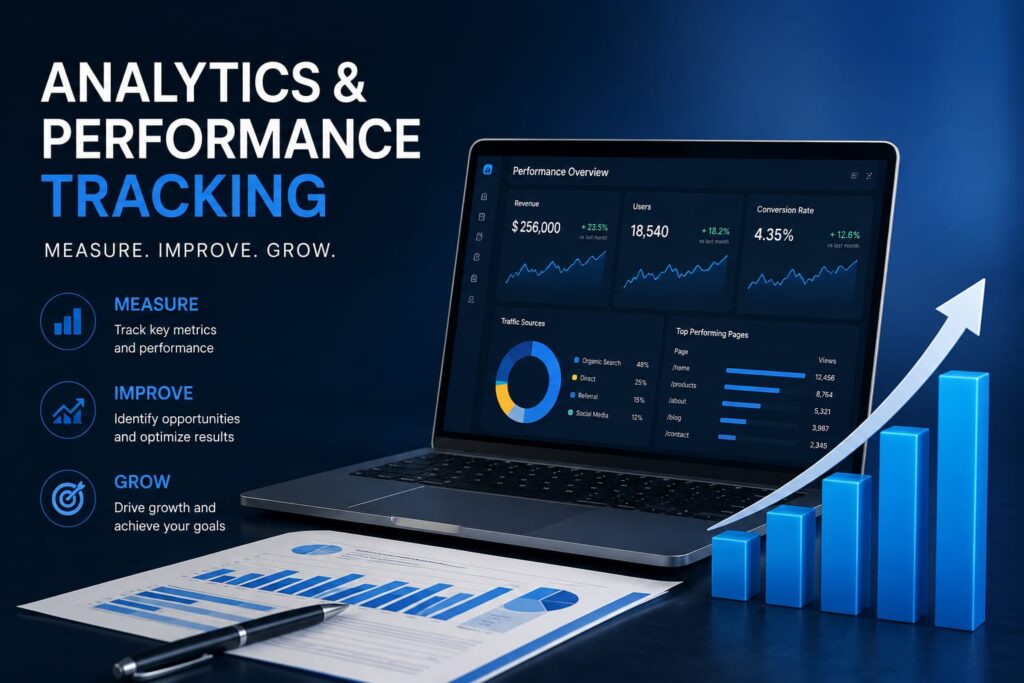
Analytics and Performance Tracking: Measure, Improve, and Grow
Part 1: Understanding Analytics and Why It Matters
Introduction
In today’s fast-paced digital landscape, businesses have access to more customer data than ever before. Every website visit, social media interaction, email click, online purchase, and advertisement engagement generates valuable information. While collecting data is relatively easy, the real challenge lies in understanding what that data means and using it to improve business performance. This is where analytics and performance tracking become essential.
Analytics and performance tracking empower businesses to make informed decisions based on measurable insights rather than assumptions. Whether you’re running a small local business, an eCommerce store, or a global enterprise, understanding how your digital marketing efforts perform is crucial for long-term success. By measuring key metrics, identifying trends, and optimizing strategies, businesses can improve customer experiences, increase conversions, reduce marketing costs, and achieve sustainable growth.
Today’s digital consumers expect personalized experiences, fast-loading websites, relevant content, and seamless online interactions. Businesses that monitor customer behavior and adapt their marketing strategies accordingly are better positioned to meet these expectations. Instead of relying on guesswork, analytics provides the evidence needed to understand what works, what doesn’t, and where improvements can be made.
In this comprehensive guide, you’ll learn how analytics and performance tracking help businesses measure success, optimize marketing campaigns, and drive continuous growth. We’ll explore essential metrics, powerful analytics tools, best practices, and practical strategies that transform raw data into meaningful business results.
What Is Analytics?
Analytics is the process of collecting, measuring, organizing, and interpreting data generated by users interacting with your digital platforms. This includes websites, mobile applications, search engines, social media channels, email campaigns, online advertisements, and eCommerce stores.
Every digital interaction leaves behind useful information. Analytics helps businesses answer important questions such as:
- How many people visited the website?
- Where did visitors come from?
- Which pages received the most traffic?
- How long did users stay on the site?
- What actions did visitors complete?
- Which marketing campaigns generated the most leads?
- Why are visitors leaving before making a purchase?
Instead of making decisions based on assumptions, analytics provides reliable evidence that helps businesses improve their digital marketing strategies.
Analytics is not just about numbers. It is about understanding customer behavior, identifying opportunities, and creating better experiences that encourage engagement and conversions.
What Is Performance Tracking?
Performance tracking is the continuous process of monitoring business goals and marketing activities using measurable data. It focuses on evaluating whether campaigns, websites, and marketing channels are achieving their intended objectives.
Performance tracking answers questions like:
- Is the SEO strategy increasing organic traffic?
- Are Google Ads generating profitable leads?
- Which social media platform delivers the highest engagement?
- Are visitors converting into paying customers?
- Which landing pages perform best?
- Is marketing investment producing positive returns?
Tracking performance consistently enables businesses to identify successful strategies while quickly recognizing areas that need improvement.
Unlike one-time reporting, performance tracking is an ongoing process. Regular analysis helps businesses adapt to changing customer behavior, market trends, and evolving business goals.
Why Analytics Matters for Business Growth Analytics and Performance
Businesses today compete in an environment where customer expectations continue to rise. Marketing budgets must produce measurable results, and every investment should contribute to business growth.
Analytics provides the information needed to make smarter decisions.
Better Decision-Making Analytics and Performance
Successful businesses rely on facts rather than assumptions. Analytics helps business owners and marketers understand exactly how their campaigns perform, allowing them to make informed strategic decisions.
Instead of guessing which marketing channels work best, analytics identifies where leads, sales, and revenue originate.
This reduces unnecessary spending while improving overall marketing efficiency.
Understanding Customer Behavior Analytics and Performance
One of analytics’ greatest strengths is its ability to reveal customer behavior.
Businesses can understand:
- Which products attract the most interest
- Which pages visitors spend the most time reading
- Where users leave the website
- Which devices customers use
- Which locations generate the most traffic
- What content encourages conversions
Understanding these behaviors allows businesses to create more personalized marketing experiences.
Improving Customer Experience Analytics and Performance
Customer experience directly influences sales and brand reputation.
Analytics identifies problems that negatively impact users, including:
- Slow-loading pages
- Broken links
- Difficult navigation
- Poor mobile responsiveness
- Low-performing landing pages
Fixing these issues improves satisfaction while increasing conversion rates.
Increasing Marketing Efficiency Analytics and Performance
Every marketing campaign requires time and budget.
Without analytics, businesses may continue investing in campaigns that fail to deliver results.
Performance tracking helps marketers identify:
- High-performing advertisements
- Effective keywords
- Successful content strategies
- Best-performing social media platforms
- Most profitable traffic sources
This allows marketing budgets to be allocated more efficiently.
Supporting Long-Term Growth Analytics and Performance
Businesses that consistently monitor data can adapt faster than competitors.
Rather than reacting after problems occur, analytics enables proactive decision-making.
Over time, this leads to:
- Stronger customer relationships
- Higher revenue
- Better brand visibility
- Increased customer retention
- Sustainable business growth
The Difference Between Data and Insights Analytics and Performance
Many businesses collect large amounts of data but struggle to transform it into meaningful insights.
Data consists of raw numbers such as:
- 15,000 website visitors
- 350 form submissions
- 5,000 social media impressions
- 450 online purchases
While useful, these numbers alone do not explain why certain results occurred.
Insights provide context.
For example:
- Organic search generates the highest-quality leads.
- Mobile users abandon checkout more frequently than desktop users.
- Blog articles attract more visitors than product pages.
- Email campaigns convert better during weekday mornings.
Insights help businesses understand the reasons behind performance and identify opportunities for improvement.
The ultimate goal of analytics is not simply collecting information but turning that information into actionable strategies.
Building a Data-Driven Business Culture Analytics and Performance
Organizations that embrace analytics develop a culture of continuous improvement.
Rather than relying on opinions, decisions are based on measurable evidence.
Marketing teams can evaluate campaign performance, sales teams can identify lead sources, customer support teams can understand common user issues, and business leaders can confidently invest in strategies backed by reliable data.
A data-driven culture also encourages experimentation. Businesses can test new ideas, measure outcomes, and refine strategies without unnecessary risk. This continuous cycle of measuring, learning, and improving helps organizations stay competitive in an ever-changing digital environment.
Companies that prioritize analytics are better equipped to respond to market trends, understand customer expectations, and achieve long-term success. Instead of reacting to changes, they use data to anticipate opportunities, improve decision-making, and build stronger relationships with their customers.
Key Metrics, Analytics Tools, and Performance Measurement Analytics and Performance
Understanding the importance of analytics is only the first step. To make informed business decisions, you need to measure the right metrics and use reliable tools to collect accurate data. Tracking meaningful Key Performance Indicators (KPIs) helps you evaluate whether your digital marketing efforts are moving your business closer to its goals. By focusing on actionable insights rather than vanity metrics, businesses can improve campaign performance, optimize marketing budgets, and deliver better customer experiences.
Key Performance Indicators (KPIs) Every Business Should Track Analytics and Performance
KPIs are measurable values that indicate how effectively your business is achieving specific objectives. Selecting the right KPIs depends on your business goals, but several metrics are essential for almost every digital marketing strategy.
Website Traffic Analytics and Performance
Website traffic measures the number of visitors who access your website during a specific period. Monitoring traffic trends helps businesses understand audience growth and evaluate the effectiveness of different marketing channels.
Traffic is commonly categorized into:
- Organic Traffic: Visitors who arrive through search engines such as Google.
- Direct Traffic: Users who type your website URL directly into their browser.
- Referral Traffic: Visitors coming from other websites or online directories.
- Social Traffic: Users arriving through social media platforms.
- Paid Traffic: Visitors generated through advertising campaigns.
Comparing these traffic sources helps determine which marketing channels produce the highest-quality visitors.
User Engagement Metrics Analytics and Performance
Attracting visitors is only part of the process. Understanding how they interact with your website is equally important.
Important engagement metrics include:
- Average session duration
- Pages viewed per session
- Scroll depth
- Returning visitors
- Bounce rate
- Engagement rate
High engagement often indicates that your content is useful, relevant, and valuable to your audience.
Conversion Rate Analytics and Performance
A conversion occurs when a visitor completes a desired action on your website. Depending on your business, conversions may include:
- Purchasing a product
- Filling out a contact form
- Booking an appointment
- Downloading an eBook
- Signing up for a newsletter
- Requesting a consultation
The conversion rate measures the percentage of visitors who complete these actions. Improving conversion rates often has a greater impact on revenue than simply increasing website traffic.
Click-Through Rate (CTR) Analytics and Performance
CTR measures how many people click on your advertisements, search engine listings, or email links after seeing them.
A strong CTR usually indicates:
- Compelling headlines
- Relevant keywords
- Effective ad copy
- Clear calls to action
Monitoring CTR helps businesses improve messaging and audience targeting.
Customer Acquisition Cost (CAC) Analytics and Performance
Customer Acquisition Cost represents the average amount spent to acquire one new customer.
It includes expenses such as:
- Advertising
- Content marketing
- SEO
- Social media campaigns
- Email marketing
- Sales efforts
Reducing acquisition costs while maintaining lead quality increases overall profitability.
Return on Investment (ROI) Analytics and Performance
ROI measures how much revenue your marketing activities generate compared to the amount invested.
A positive ROI indicates successful campaigns, while a negative ROI highlights areas requiring optimization. Measuring ROI ensures that marketing budgets are allocated efficiently and contribute to business growth.
Essential Analytics Tools Analytics and Performance
Modern businesses rely on several analytics platforms to monitor digital performance. Each tool provides unique insights that help improve marketing strategies.
Google Analytics 4 (GA4) Analytics and Performance
Google Analytics 4 (GA4) is one of the most powerful tools for tracking website performance. It provides detailed insights into user behavior across websites and mobile apps.
GA4 allows businesses to monitor:
- Website visitors
- User journeys
- Events and interactions
- Conversions
- Audience demographics
- Device usage
- Geographic locations
- Traffic sources
Unlike previous versions, GA4 uses an event-based data model, providing more accurate insights into customer interactions across multiple devices.
Google Search Console
Google Search Console is an essential tool for monitoring your website’s visibility in search engine results.
It provides information about:
- Search impressions
- Clicks
- Average keyword rankings
- Indexing status
- Mobile usability
- Core Web Vitals
- Technical SEO issues
By regularly reviewing Search Console reports, businesses can improve keyword rankings and fix technical issues that affect organic traffic.
Google Ads Reporting
For businesses investing in paid advertising, Google Ads reporting helps evaluate campaign performance.
Important metrics include:
- Cost per click (CPC)
- Conversion rate
- Cost per acquisition (CPA)
- Impression share
- Quality Score
- Return on ad spend (ROAS)
These insights help marketers refine targeting, improve ad copy, and maximize advertising budgets.
Social Media Analytics
Every major social media platform provides built-in analytics dashboards that measure campaign performance.
Common metrics include:
- Reach
- Impressions
- Likes
- Comments
- Shares
- Video views
- Follower growth
- Link clicks
Tracking social media performance helps businesses identify the content that resonates most with their audience and improve engagement strategies.
Heatmaps and User Behavior Tools
Heatmapping software helps businesses visualize how visitors interact with web pages.
These tools reveal:
- Where users click
- How far they scroll
- Which sections receive the most attention
- Areas visitors ignore
This information helps improve website layout, navigation, and calls to action.
Building Effective Performance Dashboards
Dashboards simplify analytics by displaying important metrics in one centralized location.
An effective marketing dashboard should include:
- Website traffic
- Organic search performance
- Conversion rate
- Revenue
- Lead generation
- Advertising performance
- Social media engagement
- Email campaign performance
Interactive dashboards enable marketing teams and business owners to identify trends quickly and make informed decisions without reviewing multiple reports.
Conversion Tracking
Conversion tracking is one of the most valuable aspects of performance measurement. It allows businesses to understand exactly which marketing activities generate leads and sales.
Conversions may include:
- Contact form submissions
- Product purchases
- Phone calls
- Newsletter subscriptions
- Quote requests
- Appointment bookings
- App downloads
By tracking these actions, businesses can identify high-performing campaigns and optimize those that underperform.
Using Reports to Drive Continuous Improvement
Collecting data alone is not enough. Businesses must review reports regularly and act on the insights they provide.
Monthly performance reviews can help answer questions such as:
- Which marketing channels delivered the highest ROI?
- Which pages generated the most conversions?
- Where are users dropping off?
- Which campaigns need improvement?
- How has performance changed compared to previous months?
By analyzing trends over time rather than focusing on short-term fluctuations, businesses can make smarter decisions and achieve sustainable growth.
Analytics should be viewed as an ongoing process of measuring, learning, testing, and improving. Every report provides an opportunity to refine strategies, enhance customer experiences, and strengthen overall business performance.